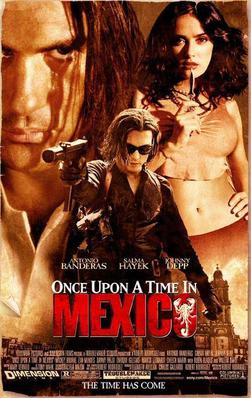
Depp's Magnetic Turn and the Enigmatic Narrative of Erase una vez en Mexico
In the vast landscape of Robert Rodriguez's gritty, stylish Mexico Trilogy, the final installment, Erase una vez en Mexico (known internationally as Once Upon a Time in Mexico), stands out not just for its explosive action and vibrant aesthetic, but for igniting a passionate debate among cinephiles. Released in 2003, this neo-Western action film brought back Antonio Banderas as the iconic El Mariachi, but it was arguably Johnny Depp's scene-stealing performance as the enigmatic CIA agent Sheldon Sands that truly captured the audience's imagination. Alongside the praise for Depp, the film also sparked considerable discussion regarding its intricate, often convoluted, plot and the curious decision to relegate its traditional protagonist to an almost secondary role. This article delves into the enduring legacy of Erase una vez en Mexico, exploring Depp's unforgettable portrayal and dissecting the narrative choices that continue to fuel the plot debate.
The Enigmatic Sheldon Sands: Dissecting Johnny Depp's Performance
When Johnny Depp entered the fray of Erase una vez en Mexico as CIA agent Sheldon Sands, he didn't just play a character; he embodied a force of nature. Sands is a man of contradictions: outwardly charming and impeccably dressed, yet morally ambiguous and capable of extreme violence. His signature move, the "psychic eye," and his bizarre penchant for philosophical musings amidst chaos, quickly made him the film's undeniable standout. Critics and audiences alike lauded Depp's ability to inject such eccentricity and charisma into a role that, on paper, might have been a mere supporting character.
Depp's performance is a masterclass in controlled chaos. He navigates Sands's journey from a calculated manipulator to a man seeking personal vendetta with a captivating blend of dark humor and understated menace. His portrayal is often cited as one of the film's strongest assets, providing a magnetic focal point amidst the sprawling narrative. It's a performance that solidifies Depp's reputation for taking unconventional roles and turning them into iconic figures. Sands isn't just a cool spy; he's a walking, talking enigma who perfectly complements Rodriguez's hyper-stylized world.
For aspiring actors or those interested in character development, Depp's work in Erase una vez en Mexico offers valuable insights into creating depth through nuance and physical expression. The way Sands adapts to his sudden, unexpected challenges, always maintaining a detached, almost philosophical calm, demonstrates a commitment to character consistency despite external pressures. His memorable lines and distinctive mannerisms have cemented Sands as a fan favorite, proving that a supporting role can often overshadow the main act with the right blend of writing and performance.
Plotting a Revolution: The Narrative Labyrinth of Once Upon a Time in Mexico
Beyond Depp's captivating turn, the narrative of Erase una vez en Mexico itself became a major talking point. The film intricately weaves multiple storylines involving a corrupt general, a powerful drug lord, a presidential assassination plot, and El Mariachi's personal quest for revenge after the death of his wife, Carolina (Salma Hayek). CIA agent Sands orchestrates much of the chaos, recruiting El Mariachi to kill General Emiliano Marquez, who is in turn hired by drug lord Armando Barillo to assassinate the President of Mexico and overthrow the government during a period of unrest.
This complex web of alliances, betrayals, and overlapping objectives led many critics to describe the plot as "convoluted." While some appreciated its intricate design, others felt it sacrificed clarity and focus, making it challenging to follow the numerous threads. The sheer volume of characters, each with their own agenda, contributes to this narrative density. From Agent Sands playing all sides to Barillo's elaborate plans and El Mariachi's personal vendetta clashing with national politics, the film demands a viewer's full attention to piece together the full picture.
However, director Robert Rodriguez himself offered an explanation that sheds light on these narrative choices. In the special features of the film's DVD, Rodriguez revealed his intention for Erase una vez en Mexico to be his trilogy's equivalent of Sergio Leone's The Good, the Bad and the Ugly. This classic Western famously broadened its scope beyond a single protagonist, introducing multiple central figures with shifting moral alignments. Seen through this lens, the film's intricate plot and diffused focus become less a flaw and more a deliberate artistic choice, aiming for a grander, more operatic scale than its predecessors.
El Mariachi's Diminished Spotlight: Intentional or Flawed?
One of the most significant points of debate surrounding Erase una vez en Mexico revolves around the reduced role of its titular protagonist, El Mariachi. Antonio Banderas, who brought such intensity and charisma to the character in Desperado, found his character taking a backseat to the machinations of others, particularly Johnny Depp's Sheldon Sands. While El Mariachi's personal vendetta against General Marquez remains a driving force, his agency and screen time feel significantly diminished compared to the previous films in the Mexico Trilogy.
For many fans, this shift was jarring. The expectation was for the final chapter to culminate in El Mariachi's ultimate triumph or tragedy, keeping him at the narrative's heart. Instead, the film decentralizes him, using him as a pawn in Sands's larger game, only occasionally taking center stage for his signature action sequences. Critics highlighted this as a point of contention, suggesting it weakened the emotional core of the trilogy by sidelining its established hero.
Yet, when viewed through Robert Rodriguez's stated intent to emulate The Good, the Bad and the Ugly, this choice gains a different perspective. In Leone's film, Clint Eastwood's "Man with No Name" is undeniably central, but the narrative equally focuses on Lee Van Cleef's Angel Eyes and Eli Wallach's Tuco. The film becomes an ensemble piece, exploring how different characters' paths intersect within a larger, tumultuous setting. Similarly, Rodriguez's vision for Erase una vez en Mexico might have been to create a multi-faceted narrative where the 'hero' is just one piece of a grander, more chaotic tapestry of revenge, revolution, and corruption in Mexico. This intentional de-emphasis allows other characters, like Sands, to shine and adds layers to the moral ambiguity that permeates the film.
Beyond the Big Screen: The Broader Cultural Impact of "Erase una vez" in Mexico
While Erase una vez en Mexico is undoubtedly the most famous cinematic use of the phrase in an international context, the Spanish idiom "Erase una vez" (meaning "Once Upon a Time") carries a much broader cultural resonance in Mexico and the Spanish-speaking world. It's the quintessential opening to any story, particularly fairy tales, instantly evoking a sense of narrative and wonder. This ubiquity means that the phrase pops up in various forms of media and literature, far beyond the confines of Robert Rodriguez's neo-Western.
For example, the phrase takes on an entirely different, yet equally captivating, life in the literary world. Mexican author Ailin Skye (Gabriela Orendain Díaz) uses it as the title for her self-published anthology, Erase Una Vez, Vol. 1: Antologia. This collection reimagines classic fairy tales like "Little Red Riding Hood," "Snow White," and "Pinocchio" with adult themes of sensuality, passion, and paranormal romance, blending irreverent humor with erotic elements in modern settings. Skye's work demonstrates how deeply ingrained the "erase una vez" concept is in Mexican storytelling, evolving from childhood fables to sophisticated adult narratives. This unique blend of traditional storytelling and contemporary themes highlights the phrase's versatility and its power to anchor diverse narratives.
The phrase also appears in other cultural contexts, such as the 2007 Mexican telenovela "Lola, Erase una vez," starring Eiza González, further illustrating its wide-ranging application in popular culture. This broader understanding of "erase una vez" enriches our appreciation of the film's title, connecting it to a deeper tradition of storytelling and narrative exploration within Mexican culture. To delve further into these fascinating connections, consider exploring Erase una vez en Mexico: Film, Books, & Pop Culture Connections.
Conclusion
Erase una vez en Mexico remains a compelling and often debated entry in the neo-Western genre. While its intricate plot and the unconventional scaling back of its protagonist El Mariachi initially drew criticism, Robert Rodriguez's vision to craft his own "The Good, the Bad and the Ugly" provides valuable context, inviting viewers to appreciate its grander, ensemble-driven narrative. Yet, for many, the film's enduring appeal lies inextricably with Johnny Depp's unforgettable portrayal of Sheldon Sands—a character so eccentric, so charismatic, and so utterly magnetic that he effortlessly stole every scene he was in. Depp's performance, combined with Rodriguez's audacious storytelling, ensures that Erase una vez en Mexico continues to spark discussion and captivate audiences, solidifying its place as a unique and memorable cinematic experience.